
What Is Bandhej? The Traditional Tie-Dye Craft Behind Indian Ethnic Wear
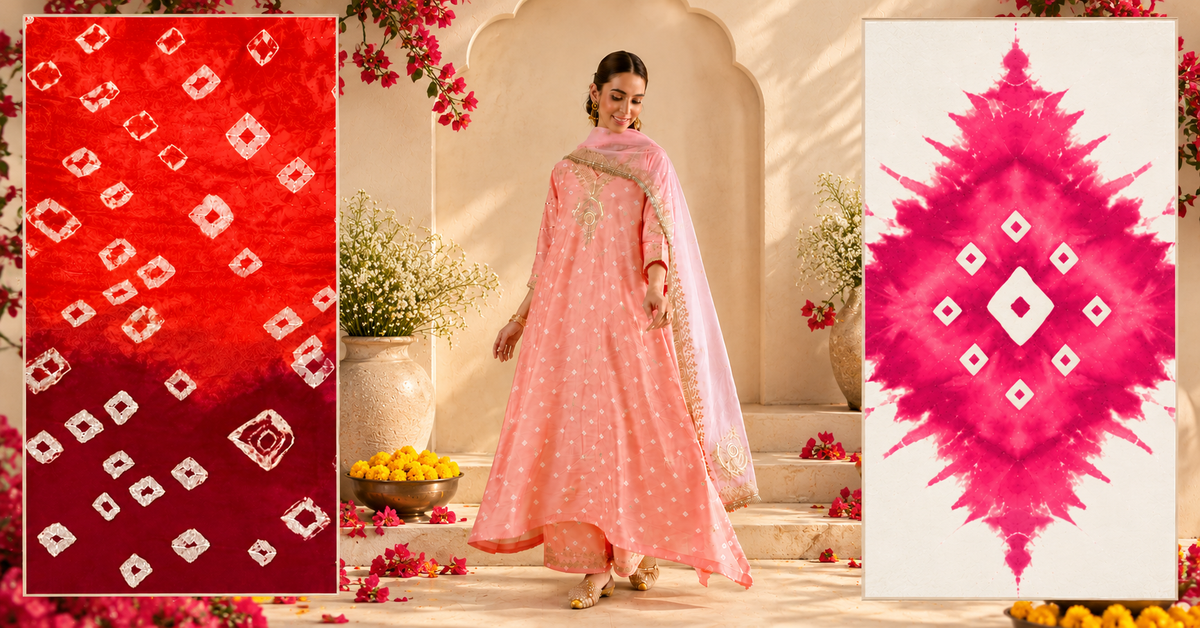
Bandhej is a traditional Indian tie-dye technique in which artisans pinch small points of cloth, bind each one with thread, and then dye the fabric. The bound points resist colour and remain light, forming dots that gather into motifs. Bandhej names a technique, not a fabric, and is closely associated with Rajasthan and Gujarat.
Every dot on a bandhej dupatta began as a knot. So what is bandhej in practice? Below: how it works, what history can and cannot tell us, and how to wear it today.
What Is Bandhej and How Is It Made?
The name comes from a Sanskrit root meaning “to tie,” which is the whole idea. A small pinch of cloth is wound tightly with thread. In the dye bath, the wound spot stays shielded and keeps its original shade as a round dot. Repeated across a border, pallu or full body, the dots read as flowers, waves or grids.
Because people tie and dye each piece, small differences are normal. Variation alone, however, does not prove authenticity.
The History and Cultural Significance of Bandhej in India
Bandhej history begins with a caveat: nobody can name the year or place the craft began. The Craft Revival Trust cites the Ajanta cave paintings, dated to roughly the 2nd to 5th centuries CE, where figures wear dotted cloth. That points to a long tradition of tying and dyeing, not a fixed origin.
The same source names Jamnagar, Anjar and Bhuj as Gujarat centres, and notes that villages kept their own palettes according to local custom. Bandhej of Rajasthan is equally established. The technique has patterned turbans, skirts and saris, and remains familiar at weddings and festivals.
Understanding the Traditional Bandhej Technique
- Mark. The areas to carry the pattern are chosen.
- Tie. Each pinch is wrapped with thread.
- Dye. The bundled cloth enters the dye bath.
- Dry and untie. The thread comes off once dry.
- Reveal. Undyed dots show against the colour.
For multicoloured work, Global Indian Craft describes moving from light to dark: the palest shade first, those spots tied off, then a deeper colour, with the last dip deciding the background.
Bandhej vs Bandhani: Is There a Difference?
Not in technique. Both describe tying cloth before dyeing. Sources only disagree on naming: the Craft Revival Trust links bandhej with Gujarat and bandhini with Rajasthan, while a CBSE textile design syllabus does the reverse. We treat the two as interchangeable.
Which Fabrics Are Used for Bandhej?
Bandhej fabric is shorthand for cloth that carries the technique. Cotton and silk are traditional bases; the RISD Museum holds an early 1900s silk bandhani scarf. Lighter cloth generally falls in soft folds, while sturdier cloth keeps its shape.
Chanderi is a separate matter: a woven fabric from Madhya Pradesh, made in silk, cotton and silk-cotton versions. Chanderi describes the weave and bandhej describes the pattern, so one does not guarantee the other.
Why Does Bandhej Remain Popular in Indian Ethnic Wear?
The dots are unmistakable, and the contrast between ground and pattern gives a simple cut character. The same technique suits a straight kurta, an anarkali or a dupatta, and it is tied to celebration.
Machine-printed imitations exist; the Craft Revival Trust notes they compete with handcrafted work. Prints tend to repeat a motif exactly, while tied work carries tiny irregularities. Since that alone proves nothing, check how the seller describes the making.
Exploring Bandhej Through Asrumo’s Collection
If this guide has you curious about wearing the craft, we’d suggest starting with The Bandhej Edit. It brings together our kurta sets and anarkalis in blues, greens, purples, reds and yellows, so you can choose by colour as well as silhouette.
Here are the two pieces we’d point you to first.
We recommend: Rust Hand Bandhej Suit Set
Choose this if you want bandhej with more detailing. It is made in Chanderi, with dense dot patterns and zari taari embroidery on the yoke and cuffs. It comes with a Kiran organza dupatta, and the kurta has pockets, which makes it practical for a long festive day.


We recommend: Blue Handcrafted Bhandhej Anarkali
Choose this if you prefer a flowing silhouette. It is made with Rajasthan’s tie-dye technique and comes with a churidar and dupatta. It suits day festivities and cultural gatherings.
How to Care for Bandhej Clothing
Follow the garment’s care label, as silk blends may need dry cleaning. Wash hand-dyed pieces apart from pale clothes, since colour can transfer. Dry them in shade, away from prolonged direct sun, and store folded in breathable cotton or muslin.
Conclusion
Every bandhej dot is a knot someone chose to tie, and every slight variation is the mark of a human hand. Asrumo brings that craft into suit sets and anarkalis for today’s wardrobes. The Bandhej Edit is a good place to see how it looks in practice.
FAQ’s
Q1. What is Bandhej ?
Bandhej is a tie-dye technique, not a fabric. It is applied to cloth such as cotton, silk or Chanderi by tying small points before dyeing, so those points stay undyed.
Q2. What is the difference between Bandhej and Bandhani?
None in technique. Both mean tying cloth before dyeing, and sources differ on which name belongs to which region, so the terms are widely used interchangeably.
Q3. Which fabrics are commonly used for Bandhej?
Cotton and silk are traditional choices. Newer garments also use Chanderi, georgette and muslin, with organza popular for dupattas. Fabric and dye technique are separate choices.
Q4. Can Bandhej suit sets be worn to weddings?
Yes. Bandhej has long been associated with weddings and celebrations. Deeper colours, zari work and an organza dupatta suit evening functions; softer shades suit daytime ceremonies.